
TES Lore: Contradictions, Mysteries, and Unclear FactsTES: Who is The One? |
 |
Some of you may have wondered after whom the Temple of the One in the Imperial City's Temple District is named. As the central structure of the Temple District, this temple is mentioned in several texts
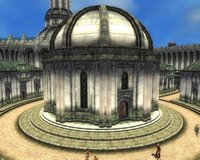 and brought up in dialogues. But who or what is "The One"? The games have not provided an answer so far. To investigate this mystery, I opened a discussion about this question in a few TES forums back in 2013, proposing three possible claims as a foundation:
The One is a god of the ancient Nords
(To consider this alternative, one must somewhat ignore the "dragonization" introduced with TES V, which turned a lot of things upside down.)
The One is Akatosh
The One is the abstract god of the Alessians
Additional information that may aid in evaluating the evidence:
After several months, I summarized the various insights from the forums and attempted to formulate a possible conclusion.
Based on the only genuinely useful clue regarding the nature of The One (provided by Symmachus), we are dealing with "an ancient Nordic cult".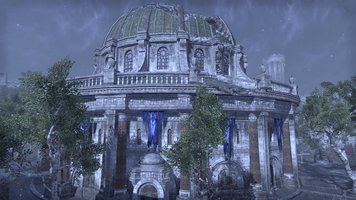 This points toward the worship of a single god, whose origins can be traced back to the ancient Nords. It is highly plausible to assume that this worship has survived within the nature-revering religion of the Skaal - the All-Maker is a singular deity worshiped by a Nordic people.
Could The One be Akatosh/Auri-El? There is strong reason for doubt, as this god presides over an entire pantheon. Wherever Akatosh is worshiped, other deities are revered alongside him - whether among the Khajiit, humans, or Elves. While Akatosh is the dominant deity, he never stands alone. This is also true for the Snow Elves: Gelebor praises Auri-El as their primary sovereign, yet he also names other gods who were worshiped by the Snow Elves in their temples.
In contrast to Akatosh, The One appears to stand entirely alone. Furthermore, Akatosh possesses a specific name within every Tamrielic culture, whereas "The One" is not an actual name.
For millennia, the temple has borne this designation. Symmachus is very clear on this matter, and he does not mention Akatosh (which he easily could have done). Tiber Septim likewise does not say "By Akatosh," but rather "By the One."
Moreover, within the eight cities of Cyrodiil, there are great chapels, each dedicated to one of the Divines. The center of Akatosh worship is located in Kvatch (Kynareth lacks her own city chapel; her shrine in the Great Forest was only introduced with Knights of the Nine).
Given how widespread Akatosh worship is, it is conceivable that his name was known within the cult of The One. However, he was not worshiped as a god there. The Skaal, for example, are well aware of other religions and deities and treat them with tolerance. Yet, their devotion belongs solely to the singular All-Maker.
Therefore, one can confidently claim that The One is not Akatosh.
The One appears to be a deity of mankind - a god focused primarily, if not exclusively, on humans. As a mortal man, Tiber Septim revived this ancient cult of the (Nordic) humans. The Skaal are also humans and worship only a single god.
One can also draw a parallel to the human Alessian Order, which fanatically rejected everything Elven. Consequently, they did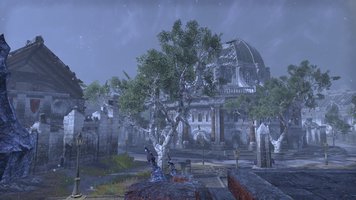 not worship an Elven god, but rather a "human" one. And their god, much like The One, possessed no actual name.
Is it conceivable that the Alessians adopted the religion of the ancient Nords? Perhaps they did so because all other gods had some form of Elven taint or connection to them. To the Alessians, the cult of The One was arguably entirely pure of Elven worship and free from Elven influences.
Thus, one could assume that the Alessians worshiped The One as their nameless, abstract deity. They did not invent a new religion; instead, they adopted the veneration of a god of mankind from the ancient Nords.
Perhaps the UESP authors followed a similar line of reasoning. They claim that the Temple of the One is dedicated to the Alessian deity. While this statement may be correct, the deity itself is likely much older than the Alessians.
The only clue suggesting that the Temple of the One was already dedicated to The One prior to the founding of the Alessian Order comes from The Book of the Dragonborn. With TES V: Skyrim, several new books were added to the lore, varying wildly in quality and conformity. Some of them contain blatant historical distortions and false statements, which disqualifies them as reliable sources of information. Unfortunately, The Book of the Dragonborn belongs to this very group. Against this background, the reference to the Temple of the One within its pages must be entirely dismissed as unreliable.
Could The One possibly be Lorkhan/Sheor/Shezarr/Sep/Shor? The Missing God? The "spirit behind all human undertaking"? The leader of humanity against the Elves? That might well be, yet it begs the question of why Alessia did not include him in the Eight Divines.
Quoted from "Shezarr and the Divines":
"Akatosh was an Aldmeri god, and Alessia's subjects were as-yet unwilling to renounce their worship of the Elven pantheon. She found herself in a very precarious political position. She needed to keep the Nords as allies, but they were (at that time) fiercely opposed to any worship of Elven deities. On the other hand, she could not force her subjects to fully reconvert to the Nordic pantheon without risking another revolution. Thus, compromises were made, and Empress Alessia established a new religion: the Eight Divines, an elegant, well-grounded synthesis of both pantheons, Nordic and Aldmeri."
Alessia acted out of political necessity. Establishing this new religion stabilized the political climate and secured peace - a well-calculated move. However, to achieve this, she had to abandon Shezarr because his fiercely anti-Elven nature no longer fit the new political and religious landscape.
She could not afford to champion a god whose sole purpose was fighting Elves.
Yet, for the later Alessians, wouldn't a divine Elf-hater have been THE absolute prime choice for a deity to worship? Shezarr embodied everything the Order stood for. For the Alessians, there could not have been a more fitting god. One could therefore claim with high probability that they worshiped Shezarr... if it weren't for the minor detail of his naming. Why didn't they call their god by his name? He possessed several - the Elven Lorkhan/Lorkhaj, the Cyrodilic Shezarr, and the Nordic Shor.
A Hypothesis:
As the name of the Order implies, the Alessians trace their roots back to the first Empress, Alessia. Under her leadership, humanity was liberated from Elven enslavement. The Alessians continued this struggle, albeit far more brutally and fanatically. It was no longer about the liberation of mankind, but about the expulsion and annihilation of the Elves. In their stubborn determination, they could not accept the Elven-tinged pantheon of the Divines. Instead, they turned to the only god who had once pursued comparable goals: Shezarr. However, Alessia had bypassed Shezarr when forming the new religion. The Alessians were caught in a dilemma: on the one hand, they respected and admired Alessia; on the other hand, they chose a god whom Alessia had abandoned.
It was a compromise. To avoid a complete contradiction with their patroness, they refrained from uttering the name that Alessia herself had kept silent. They worshiped the deity once known as Shezarr, but out of respect for Alessia, he remained nameless.
Thousands of years later, Tiber Septim did the same. As long as he waged war against Aldmeri rule, he made no attempt to "revive" Shezarr (presumably because, as the historical records state: "the memories of the follies of the Alessian Order would only have damaged his integration of the underlying Cyrodilic traditions"). But later, as Emperor, he reintroduced the Cult of the One. The fact that he, too, did not speak the name may be rooted in the reality that - ever since Alessia - Shezarr and the Divines have been fundamentally incompatible.
Accordingly, one could say that The One is the only true god of mankind. He bore several names - Lorkhan, Sheor, Shezarr, Sep, Shor - and was but one of many et'Ada. Yet, in his purpose and motivation, he was unique.
And to humanity - He was The One.
This hypothesis would provide a highly plausible answer to the original question: To whom is the Temple of the One dedicated?
However, the games up to this point, along with all their in-game literature, have lacked the ultimate proof that "The One" was indeed the nameless Alessian deity.
Verification has remained impossible due to a lack of further information.
Only a year later, the ultimate confirmation arrived with The Elder Scrolls Online. Within its incredible abundance of background information, one can find clues that elevate the aforementioned hypothesis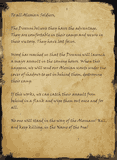 to a well-grounded thesis - or perhaps even confirm the assumption entirely.
When following the main questline in the zone of Glenumbra, you eventually find yourself at the Glenumbra Moors, where the Direnni Clan fought against the Alessian Order in the distant past. In the present timeline, Glenumbra is plagued by a werewolf infestation led by Faolchu, a seemingly invincible adversary who had previously commanded the Alessian forces centuries ago. Mysteriously, he has returned (the questline explains who is responsible for his resurrection).
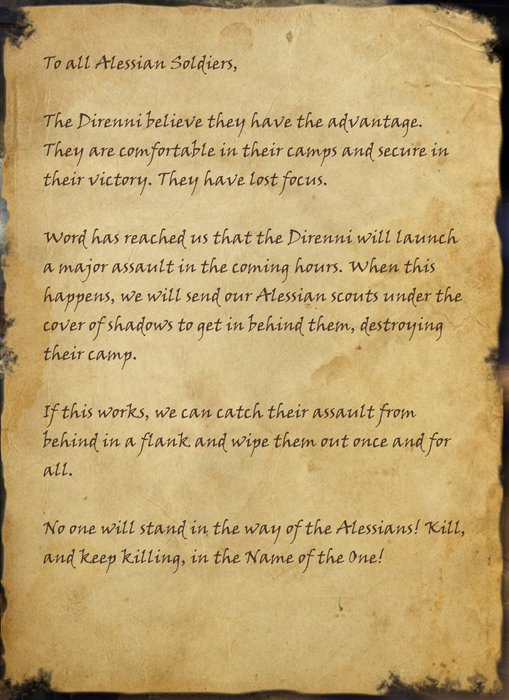
The primary objective of the quest is to discover how Faolchu was originally slain by the Direnni so that he can be destroyed once and for all. To achieve this, the Mages Guild sends the player into a vision of the past to recover this lost knowledge. During this endeavor, observant players can discover a letter containing Alessian orders. The final sentence, in particular, carries monumental significance for this entire discussion: Kill, and keep killing, in the Name of the One!
This very command can be seen as the hitherto missing piece of evidence needed to settle the debate once and for all, finally answering the question of to whom the Temple of the One in the Imperial City is dedicated: Shezarr, whose name remains unspoken in this context, becoming instead "The One".
and brought up in dialogues. But who or what is "The One"? The games have not provided an answer so far. To investigate this mystery, I opened a discussion about this question in a few TES forums back in 2013, proposing three possible claims as a foundation:The One is a god of the ancient Nords
(To consider this alternative, one must somewhat ignore the "dragonization" introduced with TES V, which turned a lot of things upside down.)
- Pro:
Perhaps the most precise statement about "The One" is made by Symmachus during Barenziah's entry into the Imperial City.
Quoted from "The Real Barenziah, Book III":
"Symmachus' quarters were in a grand building located behind the temple, just two streets away from the palace. 'The Temple of the One,' he called it as they rode past. It was an ancient Nordic cult that Tiber Septim had revived."
In general, "The One" seemed to hold a greater significance for Tiber Septim than all the other gods combined.
Quotes by Tiber Septim from "The Real Barenziah":
"By the One, we shall have the court bard set that to music."
"This the One teaches us. United we must stand against the malicious, the barbarian, the rogue[...]"
"[...]and pray the One will forgive our weakness?"
His deep connection to The One is also clear in other historical records.
Quoted from "The Real Barenziah":
"Tiber Septim had established a new tradition by decree 'in the name of the One' - and apparently, even the gods and goddesses were expected to comply with the decree."
[...]
"Rumor had it that his mages had developed spells to extend his lifespan, and it was even said that the One had granted him immortality."
Since The One whom Tiber Septim worshiped shared the exact same "name" as the temple in the Imperial City, it is highly logical to see a connection here. If "The One" is an ancient Nordic deity, the temple must have been named by the Nords at some point in history. In fact, at the end of the Merethic Era, the realm of the Nords expanded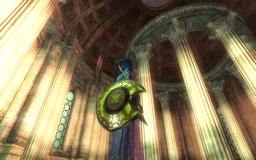 far south into the Nibenay Valley. One could assume that the Nords used the temple - originally built by the Ayleids - for their own faith back then. Later, the name of the structure was kept and never changed. Future rulers used the temple as the center of their respective religions, but the name remained. And when Tiber Septim came to power thousands of years later, he renewed this ancient faith.
The idea of an ancient, singular god of the Nords is not far-fetched, as proven by the Skaal. They are an offshoot of the Nords who still live by their original, isolated faith in a single deity: the All-Maker
Furthermore, bards in Skyrim can be heard singing the following lines:
"Hearken now, sons of snow, to an age, long ago, and the tale, boldly told, of the one!" - Contra:
If you exclude the Skaal, there are absolutely no records showing that the Nords ever worshiped only a single god. Before TES V: Skyrim, it was well established that the original Nordic pantheon consisted of Alduin, Orkey, Tsun, Kyne, Shor, and Ysmir, among others. During the era of the Alessian Empire, the Pantheon of the Eight Divines became dominant in Skyrim as well. Afterward, the Nords returned to their old gods until Reman reintroduced the Divines.
In TES V: Skyrim, the Nordic religion was expanded to include prehistoric animal worship (in order to explain the dragons somewhat plausibly). Yet even in this ancient faith, the Nords worshiped multiple deities: the Hawk, the Wolf, the Snake, the Moth, the Owl, the Whale, the Bear, the Fox, and the Dragon.
The One is Akatosh
- Pro:
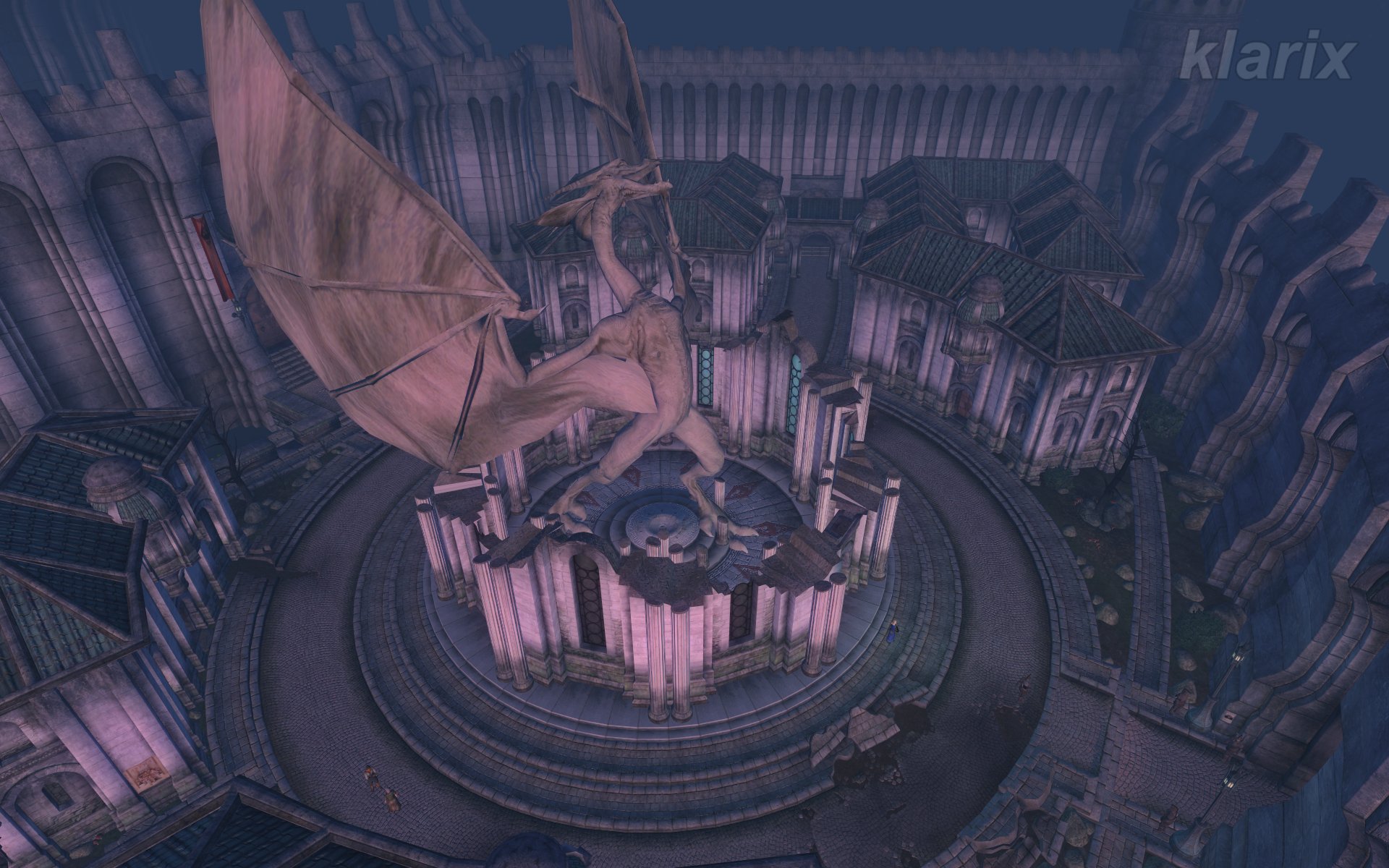
Since the end of the Oblivion Crisis, the Temple of the One has housed the massive stone statue of the dragon avatar of Akatosh , petrified after the final battle. One could therefore argue that the Temple of the One is dedicated to Akatosh, as he is the only deity depicted there - at least since the end of the Third Era.
This is likely why multiple fan sites and wikis propagate this theory as an indisputable fact with absolute certainty. - Contra:
If this religious landmark in the Temple District were truly dedicated to Akatosh, it begs the question of why it isn't simply called the "Temple of Akatosh". Throughout Cyrodiil, shrines, statues, and chapels explicitly bear the name of the deity worshiped within. Connecting these structures directly to a god's name is standard practice - and the same holds true in Skyrim (the Temple of Dibella in Markarth, of Talos in Windhelm, of Kynareth in Whiterun, and of Mara in Riften).
It is also customary to honor the worshiped deity with a visual representation. However, prior to the crisis, the Temple of the One contained no paintings, statues, or shrines whatsoever.
Furthermore, if you ask the citizens of the Imperial City about the temple, some will reply:
"- Akatosh speaks to us all, but we never listen. Go to the Temple of the One. Read the Covenants. Praise the Nine."
But they also say:
"- St. Alessia blessed our city, and all its people. Go to the Temple of the One, and renew your faith."
Or even:
"- Mara's blessing upon you, and upon all her children. Speak to her at the Temple of the One. Ask Mother Mara, and she will pour love into your heart."
Evidently, there is no consensus among the population regarding which specific god the temple belongs to, and certainly no exclusive connection to Akatosh. It is also worth noting that the UESP (Unofficial Elder Scrolls Pages) does not mention Akatosh at all in its core history of the Temple of the One.
The One is the abstract god of the Alessians
- Pro:
In its beginnings, the Alessian Order challenged Elven rule; later, Elves were actively persecuted and fought against. The Elven pantheon was pushed into the background, and in its place stepped a singular, elusive, and incomprehensible deity. This entity was so unimaginable and abstract that it did not even possess a name. It is highly possible that people simply referred to it as "The One".
The UESP states that the Temple of the One in the Imperial City was, and still is, dedicated to this specific Alessian deity. - Contra:
The nameless deity of the Alessians has long been history. There is no evidence suggesting it was still worshiped after the War of Righteousness. In the current timeline (during the events of the games), this faith is not even mentioned. It is hard to imagine that one of the most important religious landmarks would still be dedicated to a "dead" or forgotten, and certainly non-existent, god.
Furthermore, there is a chronological discrepancy: The Alessian belief in a singular god began to take shape alongside the rising influence of the Order, roughly 100 years after Alessia's death. However, The Book of the Dragonborn contains the following statement:
Quoted from "The Book of the Dragonborn":
"Most scholars agree that the term [Dragonborn] was first used in connection with the Covenant of Akatosh, when Blessed St. Alessia was given the Amulett of Kings and the Dragonfires were first lit in the Temple of the One."
Consequently, the name "Temple of the One" already existed during Alessia's lifetime. "The One" was therefore present long before the emergence of the Alessian Order, which casts doubt on the claims made by the UESP. Additionally, the UESP authors seem to confound the Alessian faith with the ancient cult that Tiber Septim later revived.
Additional information that may aid in evaluating the evidence:
- The Temple of the One was an active, influential institution. For instance, it provided sanctuary and protection to the exiled Empress Consort Caula Voria, ensuring that Jagar Tharn could harm her no further. Evidently, by the Third Era, the temple operated under a henotheistic, if not outright polytheistic, framework. Regardless of who The One originally was, Alessia Ottus notes that the Nine Divines and the communion of all saints could be worshiped within its walls.
- The Prophet in Anvil repeatedly spoke of the "Eight and One." However, this phrasing most likely refers to Talos, who was counted among the Divines in the Cyrodilic faith until the signing of the White-Gold Concordat.
- Interestingly, the Argonian Jeelius served as a priest in the Temple of the One. When thanking the player for his rescue, he curiously muses that one is being guided by Akatosh...
- A strange statement, open to various interpretations, is made by Mankar Camoran in his commentaries.
Quoted from "Commentaries on the Mysterium Xarxes, Book II":
"Whisper to earth and earth, where the ignorant offer no stones more than blood, for blood IS blood, and bone-breaking, for bone IS bone, and so break and answer and fall before the One and One, I call you, Dragon, as brother and king[...]" - Another intriguing insight into the matter can be found in the book Words and Philosophy.
Quoted from "Words and Philosophy":
"Calaxes had been named Archbishop of the One, though he was not the rightful successor, a powerful position in the Imperial City, indeed anywhere in Tamriel where that religion is honored."
Does "that religion" refer explicitly to the veneration of The One? Calaxes lived at the end of the Third Era, which would imply that at the time of the TES games preceding Skyrim, it was still a vibrant, actively practiced religion.
After several months, I summarized the various insights from the forums and attempted to formulate a possible conclusion.
Based on the only genuinely useful clue regarding the nature of The One (provided by Symmachus), we are dealing with "an ancient Nordic cult".
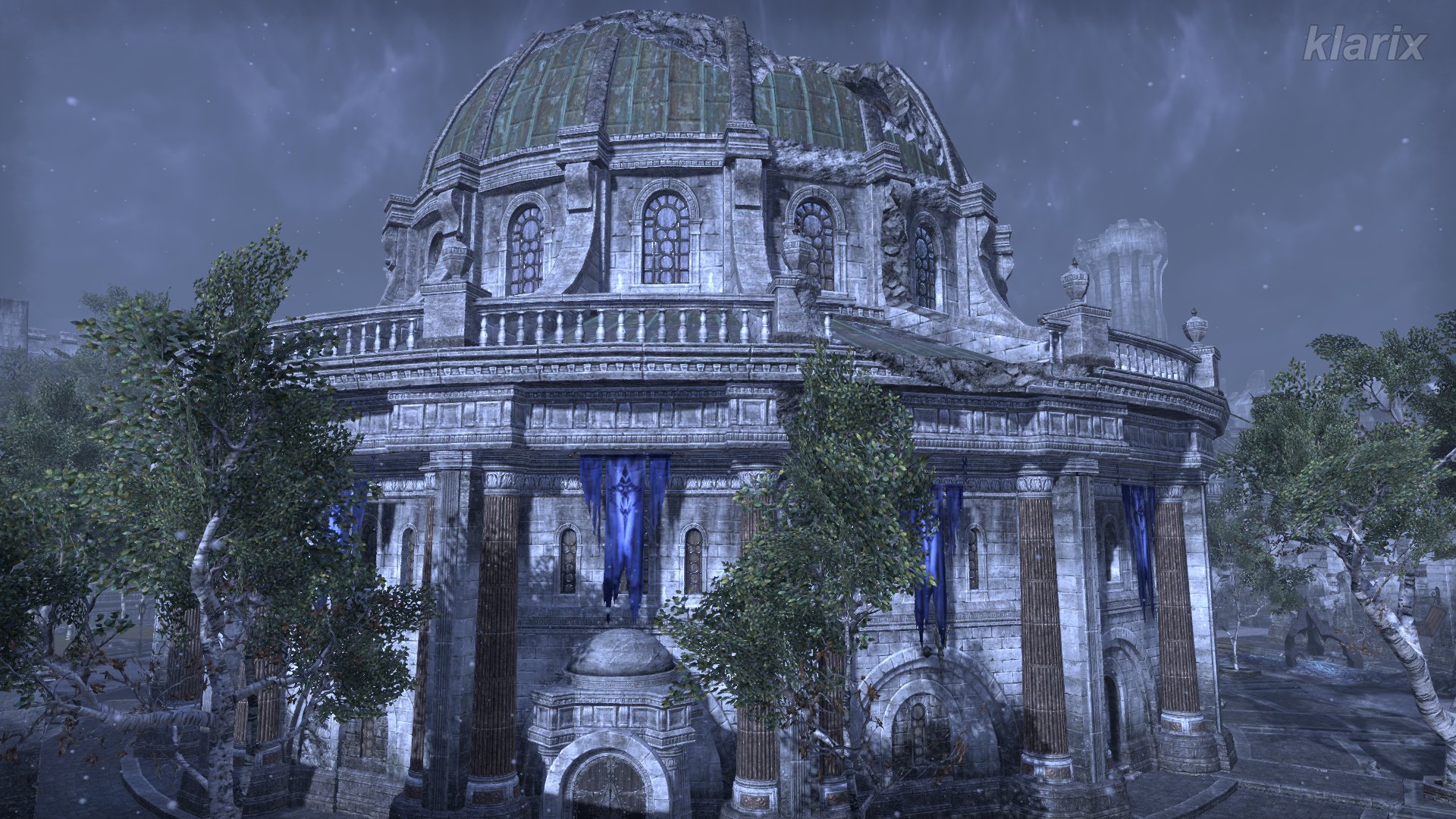 This points toward the worship of a single god, whose origins can be traced back to the ancient Nords. It is highly plausible to assume that this worship has survived within the nature-revering religion of the Skaal - the All-Maker is a singular deity worshiped by a Nordic people.
Could The One be Akatosh/Auri-El? There is strong reason for doubt, as this god presides over an entire pantheon. Wherever Akatosh is worshiped, other deities are revered alongside him - whether among the Khajiit, humans, or Elves. While Akatosh is the dominant deity, he never stands alone. This is also true for the Snow Elves: Gelebor praises Auri-El as their primary sovereign, yet he also names other gods who were worshiped by the Snow Elves in their temples.
In contrast to Akatosh, The One appears to stand entirely alone. Furthermore, Akatosh possesses a specific name within every Tamrielic culture, whereas "The One" is not an actual name.
For millennia, the temple has borne this designation. Symmachus is very clear on this matter, and he does not mention Akatosh (which he easily could have done). Tiber Septim likewise does not say "By Akatosh," but rather "By the One."
Moreover, within the eight cities of Cyrodiil, there are great chapels, each dedicated to one of the Divines. The center of Akatosh worship is located in Kvatch (Kynareth lacks her own city chapel; her shrine in the Great Forest was only introduced with Knights of the Nine).
Given how widespread Akatosh worship is, it is conceivable that his name was known within the cult of The One. However, he was not worshiped as a god there. The Skaal, for example, are well aware of other religions and deities and treat them with tolerance. Yet, their devotion belongs solely to the singular All-Maker.
Therefore, one can confidently claim that The One is not Akatosh.
The One appears to be a deity of mankind - a god focused primarily, if not exclusively, on humans. As a mortal man, Tiber Septim revived this ancient cult of the (Nordic) humans. The Skaal are also humans and worship only a single god.
One can also draw a parallel to the human Alessian Order, which fanatically rejected everything Elven. Consequently, they did
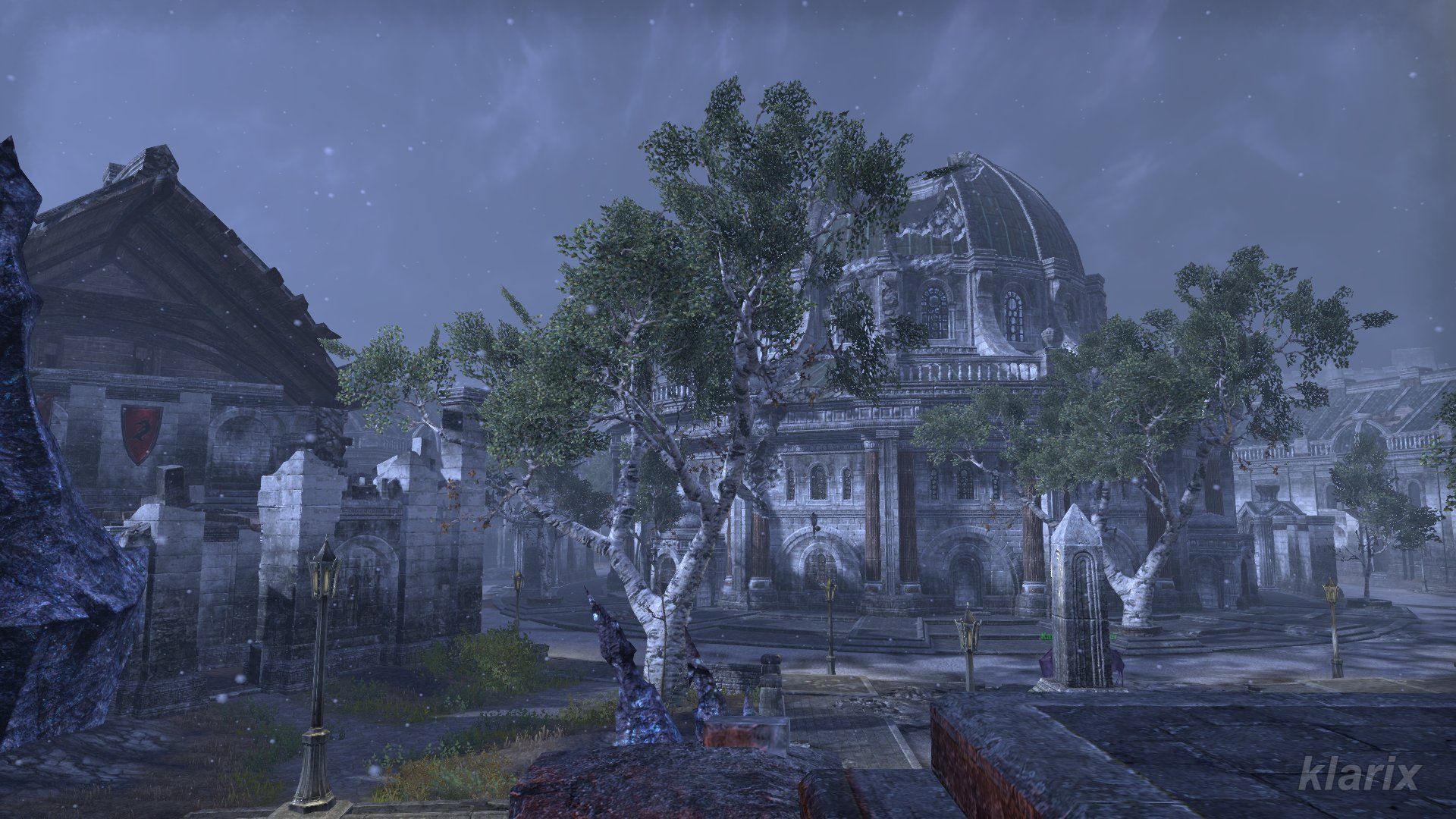 not worship an Elven god, but rather a "human" one. And their god, much like The One, possessed no actual name.
Is it conceivable that the Alessians adopted the religion of the ancient Nords? Perhaps they did so because all other gods had some form of Elven taint or connection to them. To the Alessians, the cult of The One was arguably entirely pure of Elven worship and free from Elven influences.
Thus, one could assume that the Alessians worshiped The One as their nameless, abstract deity. They did not invent a new religion; instead, they adopted the veneration of a god of mankind from the ancient Nords.
Perhaps the UESP authors followed a similar line of reasoning. They claim that the Temple of the One is dedicated to the Alessian deity. While this statement may be correct, the deity itself is likely much older than the Alessians.
The only clue suggesting that the Temple of the One was already dedicated to The One prior to the founding of the Alessian Order comes from The Book of the Dragonborn. With TES V: Skyrim, several new books were added to the lore, varying wildly in quality and conformity. Some of them contain blatant historical distortions and false statements, which disqualifies them as reliable sources of information. Unfortunately, The Book of the Dragonborn belongs to this very group. Against this background, the reference to the Temple of the One within its pages must be entirely dismissed as unreliable.
Could The One possibly be Lorkhan/Sheor/Shezarr/Sep/Shor? The Missing God? The "spirit behind all human undertaking"? The leader of humanity against the Elves? That might well be, yet it begs the question of why Alessia did not include him in the Eight Divines.
Quoted from "Shezarr and the Divines":
"Akatosh was an Aldmeri god, and Alessia's subjects were as-yet unwilling to renounce their worship of the Elven pantheon. She found herself in a very precarious political position. She needed to keep the Nords as allies, but they were (at that time) fiercely opposed to any worship of Elven deities. On the other hand, she could not force her subjects to fully reconvert to the Nordic pantheon without risking another revolution. Thus, compromises were made, and Empress Alessia established a new religion: the Eight Divines, an elegant, well-grounded synthesis of both pantheons, Nordic and Aldmeri."
Alessia acted out of political necessity. Establishing this new religion stabilized the political climate and secured peace - a well-calculated move. However, to achieve this, she had to abandon Shezarr because his fiercely anti-Elven nature no longer fit the new political and religious landscape.
She could not afford to champion a god whose sole purpose was fighting Elves.
Yet, for the later Alessians, wouldn't a divine Elf-hater have been THE absolute prime choice for a deity to worship? Shezarr embodied everything the Order stood for. For the Alessians, there could not have been a more fitting god. One could therefore claim with high probability that they worshiped Shezarr... if it weren't for the minor detail of his naming. Why didn't they call their god by his name? He possessed several - the Elven Lorkhan/Lorkhaj, the Cyrodilic Shezarr, and the Nordic Shor.
A Hypothesis:
As the name of the Order implies, the Alessians trace their roots back to the first Empress, Alessia. Under her leadership, humanity was liberated from Elven enslavement. The Alessians continued this struggle, albeit far more brutally and fanatically. It was no longer about the liberation of mankind, but about the expulsion and annihilation of the Elves. In their stubborn determination, they could not accept the Elven-tinged pantheon of the Divines. Instead, they turned to the only god who had once pursued comparable goals: Shezarr. However, Alessia had bypassed Shezarr when forming the new religion. The Alessians were caught in a dilemma: on the one hand, they respected and admired Alessia; on the other hand, they chose a god whom Alessia had abandoned.
It was a compromise. To avoid a complete contradiction with their patroness, they refrained from uttering the name that Alessia herself had kept silent. They worshiped the deity once known as Shezarr, but out of respect for Alessia, he remained nameless.
Thousands of years later, Tiber Septim did the same. As long as he waged war against Aldmeri rule, he made no attempt to "revive" Shezarr (presumably because, as the historical records state: "the memories of the follies of the Alessian Order would only have damaged his integration of the underlying Cyrodilic traditions"). But later, as Emperor, he reintroduced the Cult of the One. The fact that he, too, did not speak the name may be rooted in the reality that - ever since Alessia - Shezarr and the Divines have been fundamentally incompatible.
Accordingly, one could say that The One is the only true god of mankind. He bore several names - Lorkhan, Sheor, Shezarr, Sep, Shor - and was but one of many et'Ada. Yet, in his purpose and motivation, he was unique.
And to humanity - He was The One.
This hypothesis would provide a highly plausible answer to the original question: To whom is the Temple of the One dedicated?
However, the games up to this point, along with all their in-game literature, have lacked the ultimate proof that "The One" was indeed the nameless Alessian deity.
Verification has remained impossible due to a lack of further information.
Only a year later, the ultimate confirmation arrived with The Elder Scrolls Online. Within its incredible abundance of background information, one can find clues that elevate the aforementioned hypothesis
 to a well-grounded thesis - or perhaps even confirm the assumption entirely.
When following the main questline in the zone of Glenumbra, you eventually find yourself at the Glenumbra Moors, where the Direnni Clan fought against the Alessian Order in the distant past. In the present timeline, Glenumbra is plagued by a werewolf infestation led by Faolchu, a seemingly invincible adversary who had previously commanded the Alessian forces centuries ago. Mysteriously, he has returned (the questline explains who is responsible for his resurrection).
The primary objective of the quest is to discover how Faolchu was originally slain by the Direnni so that he can be destroyed once and for all. To achieve this, the Mages Guild sends the player into a vision of the past to recover this lost knowledge. During this endeavor, observant players can discover a letter containing Alessian orders. The final sentence, in particular, carries monumental significance for this entire discussion: Kill, and keep killing, in the Name of the One!
This very command can be seen as the hitherto missing piece of evidence needed to settle the debate once and for all, finally answering the question of to whom the Temple of the One in the Imperial City is dedicated: Shezarr, whose name remains unspoken in this context, becoming instead "The One".
|
|
 |
|